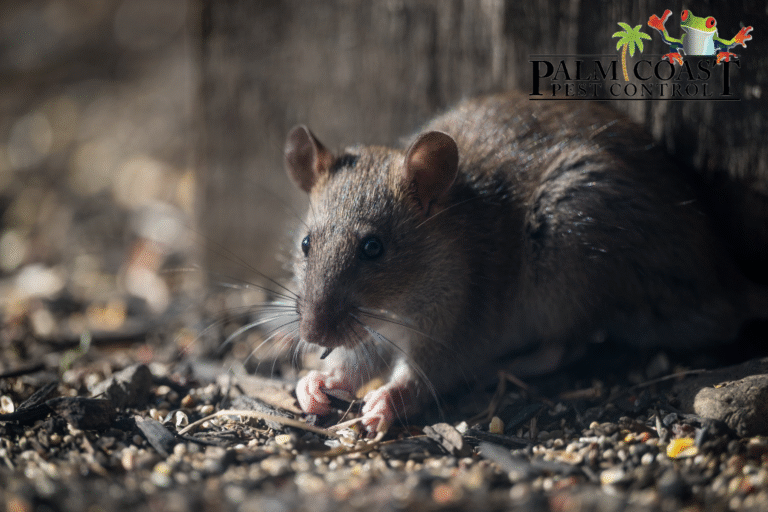
To identify entry points, inspect high-elevation gaps for Roof Rats, who prefer attics and rooflines, and ground-level burrows for Norway Rats. Look for two-inch wide greasy rub marks, gnawed wires, and capsule-shaped droppings for Norway rats, versus smaller, spindle-shaped droppings and shredded attic insulation for Roof rats. Identifying these specific structural breaches is the first step in achieving permanent, high-quality rat control.
Florida’s unique climate creates year-round pressure from rodents seeking shelter from the heat and rain. When you hear scratching in the walls or find suspicious debris in the pantry, the anxiety of an infestation can be overwhelming. At Palm Coast Pest Control, we believe that true peace of mind comes from understanding the “who” and “how” behind the invasion.
With over 35 years of local expertise, our family-run team knows that not all rats are created equal. Solving a rodent problem requires more than just setting traps; it requires a deep dive into the biological habits of the two most common culprits in our area: the Roof Rat and the Norway Rat.
Understanding where a rat enters your home depends largely on its species. While Norway rats are heavy-bodied, ground-dwelling rats, Roof rats are agile climbers that treat your gutters like a highway.
During a recent inspection for a property manager in a quiet neighborhood, our team discovered that, while the homeowner was looking for holes near the foundation, the actual entry points were located 18 feet up, near the chimney flashing, a classic sign of Roof activity.
| Feature | Roof Rat (Rattus rattus) | Norway Rat (Rattus norvegicus) |
| Preferred Entry Point | Rooflines, soffit vents, power lines | Foundation gaps, floor drains, burrows |
| Nesting Site | Attics, ceiling voids, palm trees | Basements, crawl spaces, sewers |
| Dropping Shape | Small (1/2″), pointed/spindle-shaped | Large (3/4″), blunt/capsule-shaped |
| Gnaw Marks | Small, neat holes in wood/shingles | Rough, jagged edges on thick materials |
| Grease Marks | High-up on rafters or eaves | Low-down along baseboards or pipes |
One of the most reliable ways to find where rodents are getting in is to look for “sebum” or rub marks. Rats have poor eyesight and navigate by following walls and edges. Over time, the oils and dirt in their fur leave dark, greasy stains at their frequent points of contact.
How to track active entry points:
Effective pest control in Palm Bay relies on this level of forensic detail. If you find a smudge but no hole, the entry point is likely just a few feet away.
At Palm Coast Pest Control, we don’t just “guess” where rats are hiding. We utilize our proprietary Rodent-Shield Protocol (comprising our comprehensive Rodent Reduction and Prevention Plan) to ensure your home remains a fortress.
Our process begins with an intensive mapping of your property to target nesting and foraging zones. By identifying where the rats sleep versus where they eat, we can intercept them at the source. For example, when providing Palm Bay pest control, we often find that rats forage in nearby fruit trees but nest in the climate-controlled comfort of a residential attic.
We use UV-fluorescent tracking and high-definition borescope cameras to see behind drywall and inside HVAC chases. This allows us to find breaches that are invisible to the naked eye. Once identified, we move beyond temporary fixes, using professional-grade exclusion materials that rodents cannot chew through.
While exclusion is our priority, we utilize strategic rodent baiting using the latest, proven treatment methods. Our approach is designed to be child- and pet-safe, prioritizing eco-friendly solutions that protect your family while effectively reducing the population.
The Florida East Coast demands a higher standard of service. Between the humidity and the lush landscaping, your home is constantly under siege. Choosing a pest control in Palm Bay, FL, shouldn’t be a gamble.
Our team sets itself apart by being a “one-stop” provider. Whether you need rat control, termite protection, or lawn care, we handle it all so you don’t have to juggle multiple companies. We are a family-run business that prioritizes honesty and integrity. We will never suggest a service you don’t need.
A common industry myth we encounter in Palm Bay is that natural deterrents such as peppermint oil or mothballs will keep rats out.
Here is why this misconception is dangerous:
Mechanical exclusion, physically sealing the holes, is the only 100% effective method for a long-term solution.

Q: How small a hole can a rat fit through?
A: A Roof rat can squeeze through a gap the size of a nickel (about 1/2 inch), while a Norway rat needs a hole the size of a quarter. If their head fits, their body follows.
Q: Why do I hear noises at night but see no rats?
A: Rats are nocturnal and highly secretive. They spend the daylight hours in their nesting zones. If you hear scratching, they are likely traveling through wall voids to their foraging zones.
Q: Is rodent baiting safe for my dog?
A: Yes, when performed by our professional technicians. We use tamper-resistant bait stations that are designed to keep pets and children out while allowing rodents in. Our eco-friendly treatments prioritize safety without sacrificing effectiveness.
You deserve to feel safe in your own home. When the scratching starts, and your peace of mind disappears, you need an experienced neighbor who happens to be an expert. At Palm Coast Pest Control, we combine 35+ years of technical know-how with the friendly service you’d expect from a family-run team.
We are so confident in our methods that we offer a 100% satisfaction guarantee. If the pests don’t come back, great, but if they do, so do we, at no extra cost to you. From Jupiter to Palm Bay, we are here to provide rapid relief with same-day and emergency services.
Ready to reclaim your home? Don’t wait for the damage to get worse. Schedule your Free Quote today and take advantage of our 10% discount for new customers. Let us handle the technical work so you can get back to enjoying a healthy, pest-free living space. Contact us today!